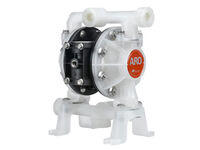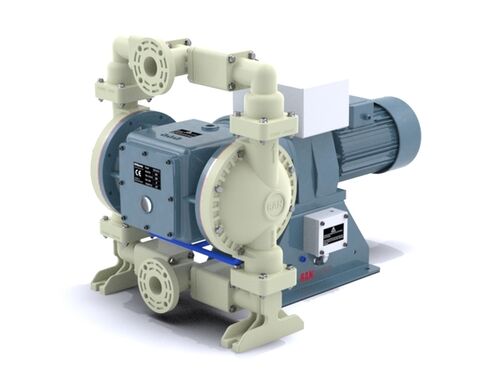























The basic principle of operation of the AODD pump is shown in the figure.
The diaphragms A and B are moved from left to right and back again by directing compressed air alternately to them via a central air valve.
The movement of diaphragm A towards the centre of the pump generates a partial vacuum in the chamber. This causes ball valve 1 to close while ball valve 2 opens as air pressure forces liquid from the inlet I into the chamber. At the same time, diaphragm B compresses the volume in its chamber, which closes valve 3 and forces fluid past valve 4 and out through the outlet port O.
When the air valve reverses the movement of the diaphragms, fluid is pumped via the left hand side of the pump. Since the diaphragms are clamped to the walls of the pumping chamber, there are no sliding seals in the pump.
The diagram shows the flow of liquid from the bottom to the top; however, some pump designs feature flap valves and in these cases, liquid flows from the top to the bottom of the pump.
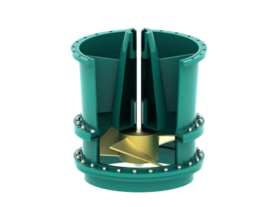
This pumping principle is used, in essence, in AODD pumps manufactured by most of the world’s leading manufacturers, such as Wilden, Warren-Rupp, Graco and Aro. However, an alternative method was introduced, originally by Flotronics and more
recently by Johnson Pump, where the fluid flows through the centre of the pump, which can lead to smoother flows.
AODD pumps contain fewer moving parts than many other types of pumps and there is therefore less maintenance. They also offer easy access to those parts that may need servicing. There are no shaft seals or packing boxes involved. The diaphragm is a dynamic seal that converts the pneumatic pressure on one side to a fluid pressure on the other (the medium to be pumped).
The differential air pressure across the diaphragm and corresponding internal stresses are low in comparison with similar stresses in mechanically driven diaphragm pumps that use the diaphragm to generate pressure. Discharge flow rates are adjusted by controlling the air inlet or the discharge flow, so no complex control systems are required.